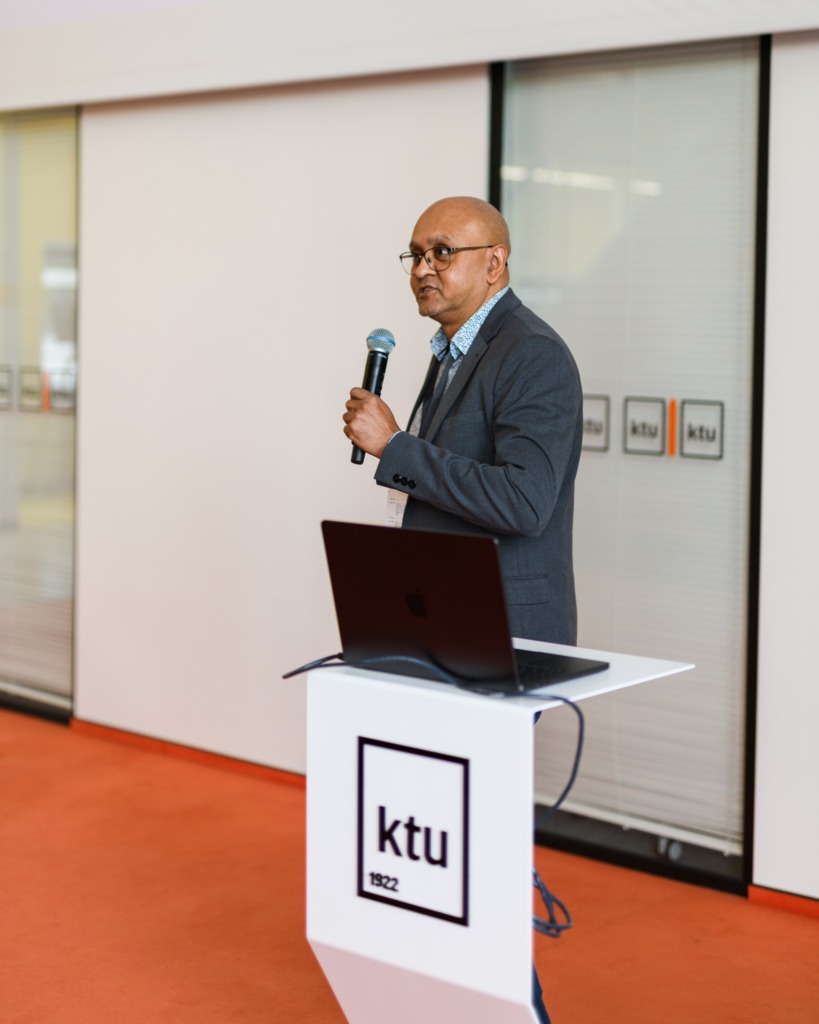
At this year’s International Conference on Information and Software Technologies (ICIST 2025), researchers, industry experts, and students gathered at Kaunas University of Technology (KTU) to explore one of the most urgent challenges of our time—how to make technology not only more insightful but also safer and more human-centred.
Among the many inspiring presentations and discussions, Dr Bilhanan Silverajan stood out for his thought-provoking insights into the hidden cultural dimension of cybersecurity.
When Technology Meets Culture
Integrating information technology (IT) with operational technology (OT)—the systems that run industrial plants, manufacturing lines, and energy grids—is often seen as a purely technical process. But as Dr Silverajan pointed out, the real difficulties frequently begin when technology ends, and human judgment begins. “It’s not just a technology problem,” he explained. “When legacy industrial systems are integrated with modern IT infrastructure, the most significant vulnerabilities emerge not from code or hardware, but from people and their organizational culture.“
This simple but powerful observation resonated with many attendees at the ICIST 2025 conference, where discussions increasingly highlighted the importance of interdisciplinary collaboration—bringing together engineers, data scientists, and social researchers to tackle cybersecurity from both technical and human perspectives.
Beyond Firewalls: The Human Element of Cybersecurity
Dr Silverajan also emphasized a broader societal challenge: our willingness to sacrifice privacy for convenience. “Today’s culture has evolved in such a way that we are willing to give up control over our data to gain more features or convenience,” he noted. “That’s dangerous, because once you give your data away, you create a digital trail that can never be fully erased.” He explained how this trade-off not only exposes individuals to risk but also fuels a self-reinforcing digital ecosystem. “You become the product—and then the customer. Companies feed you only what they think you want to see. It is a self-fulfilling prophecy, where you no longer encounter neutral information, only the filtered version that serves a business model.”
His remarks drew attention to the growing ethical and psychological aspects of cybersecurity, a topic gaining traction in both academic and policy circles. At the ICIST 2025 conference, several sessions echoed this theme, calling for education systems to integrate digital ethics and critical data literacy into IT and engineering programs.
Unexpected Lessons from Research
Looking Toward the Stars
In a lighter part of the discussion, Dr Silverajan was asked what projects he would pursue if given unlimited resources. His answer ventured far beyond Earth. “I would invest in deep-space research,” he said without hesitation. “We are reaching a point where autonomous, self-learning robots could help humanity explore new frontiers. Deep-space exploration could open up access to new minerals and even create living spaces for humans within the next 50 or 60 years.”
His words captured the spirit of curiosity, ambition, and a belief in technology’s potential to serve humanity—when guided by responsibility and collaboration. “Of course,” he added with a smile, “after that, maybe I’d also work on world peace.”